
Chapter 2
Evolution
Chapter 2
Evolution
A mutation is a change in the living organism. Most mutations are of no use or cannot be exploited. Only the useful ones stick. These are the mutations that benefit the organism. (When we built boats, we only built those that came back). Mutations that do not benefit the organism are repressed from lack of use. (you lose what you don’t use). Appendix, tailbone, talent, mind, etc. Simple, works every time. Some changes could improve life and survival in a brutal environment.
MENU
1_PROFESSOR RICHARD DAWKINS
2_PROFESSOR DANIEL DENNETT
3_CHARLES DARWIN
4_DARWIN’S BEAGLE
1_PROFESSOR RICHARD DAWKINS
www.richarddawkins.com(opens in new tab)
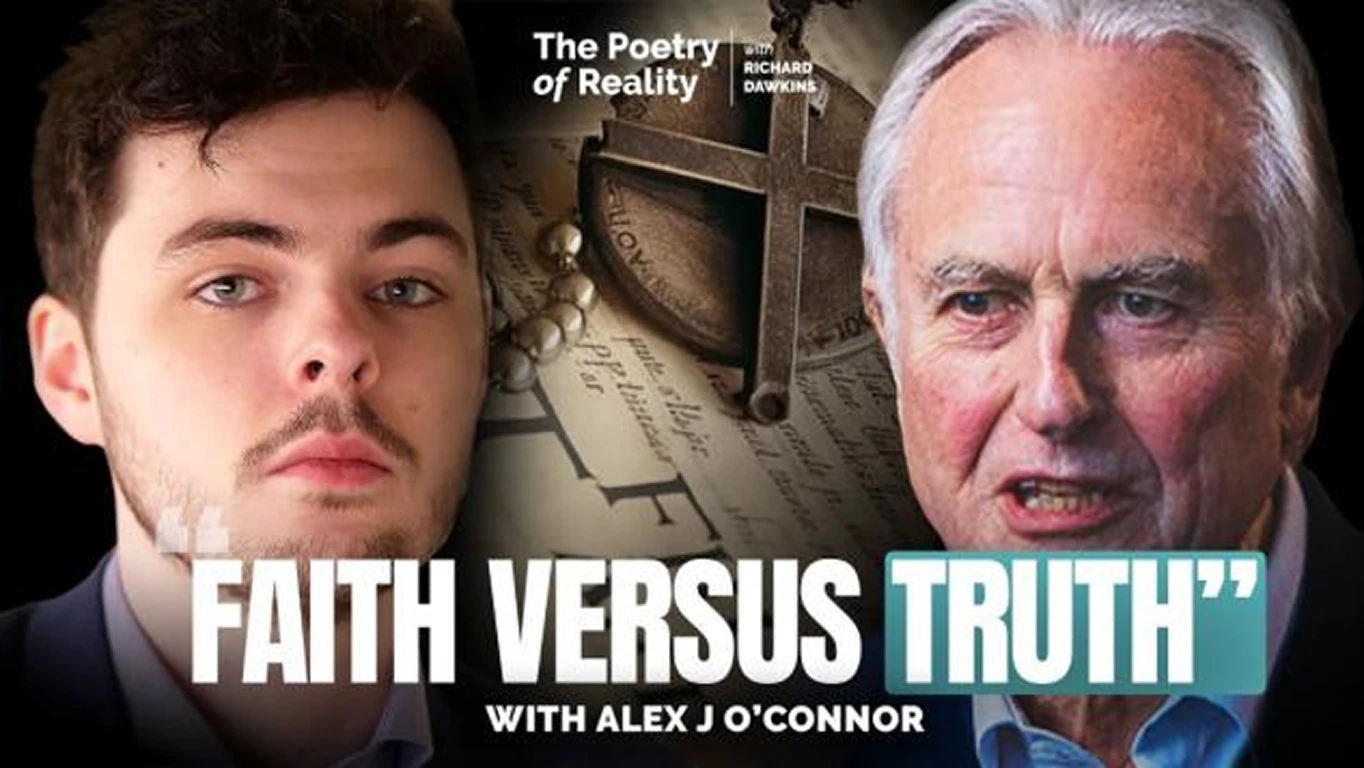
Richard Dawkins (born 26 March 1941) is a British evolutionary biologist, zoologist, science communicator and author. He is an emeritus fellow of New College, Oxford. In 1995 he was named the first Simonyi Professor for the Public Understanding of Science, a position he held until 2008, and is on the advisory board of the University of Austin.
Dawkins has won several academic and writing awards, among them the 2005 Shakespeare Prize and the 2006 Lewis Thomas Prize. Presenting the latter, Paul Nurse said “In eloquent, evocative prose, Richard Dawkins conveys the certainty that, rather than diminishing the myriad beauties of the universe and extinguishing wonderment at its mysteries, science reveals truths that are yet more awe-inspiring than the mysteries they solve.”
Known as Darwin’s Rottweiler, Dawkins has written a number of popular books explaining evolution. In The Selfish Gene (1976), he popularised the gene-centred view of evolution and coined the word meme. In The Blind Watchmaker (1986), he explains how the cumulative, non-random process of natural selection, coupled with random variation, creates complexity.
In Climbing Mount Improbable (1996), he explores how evolution gradually creates complex adaptations through a series of intermediates. The book grew out of his Royal Institution Christmas Lectures, Growing Up in the Universe. With Yan Wong, he co-authored The Ancestor’s Tale (2004), a “Chaucerian pilgrimage to the dawn of life.”
2_PROFESSOR DANIEL DENNETT
Deceased just search his name for hundreds of u-tubes, video, books and debates
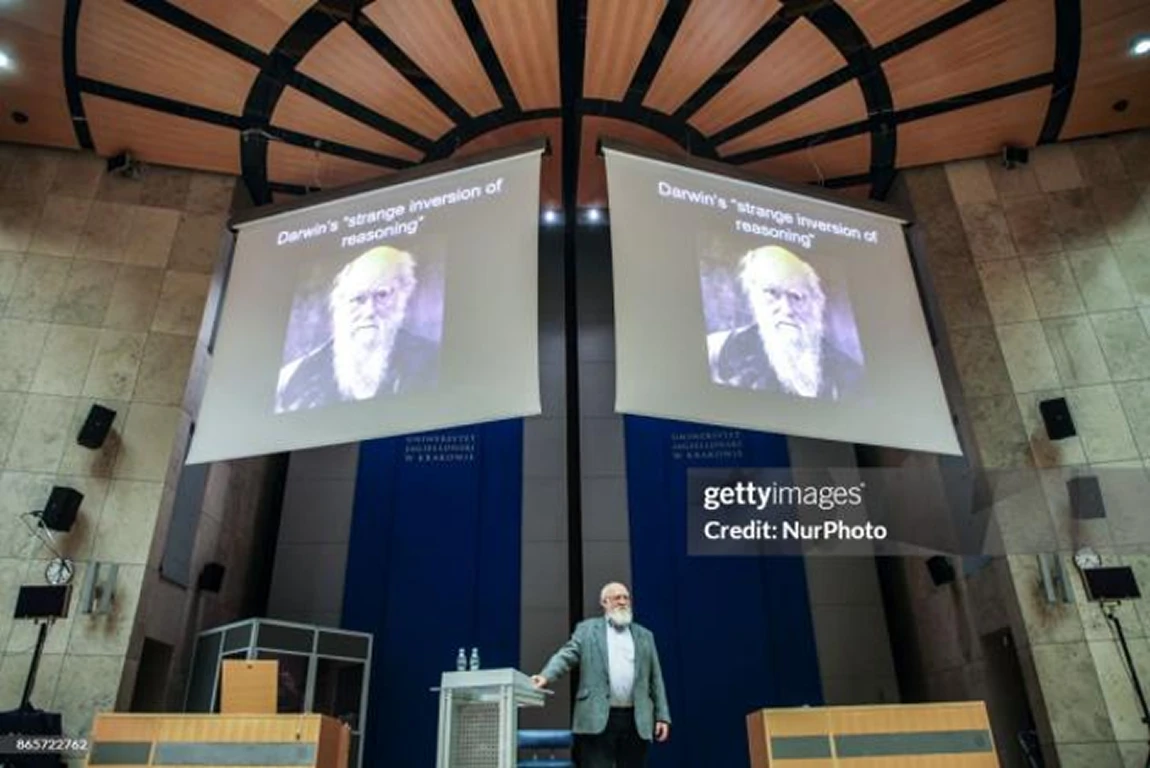
Daniel Clement Dennett III (March 28, 1942 – April 19, 2024) was an American philosopher and cognitive scientist(opens in new tab). His research centered on the philosophy of mind(opens in new tab), the philosophy of science(opens in new tab), and the philosophy of biology(opens in new tab), particularly as those fields relate to evolutionary biology(opens in new tab) and cognitive science(opens in new tab).
Dennett was the co-director of the Center for Cognitive Studies and the Austin B. Fletcher Professor of Philosophy at Tufts University(opens in new tab) in Massachusetts(opens in new tab). Dennett was a member of the editorial board(opens in new tab) for The Rutherford Journal(opens in new tab) and a co-founder of The Clergy Project(opens in new tab).
A vocal atheist(opens in new tab) and secularist(opens in new tab), Dennett has been described as “one of the most widely read and debated American philosophers”. He was referred to as one of the “Four Horsemen(opens in new tab)” of New Atheism(opens in new tab), along with Richard Dawkins(opens in new tab), Sam Harris(opens in new tab), and Christopher Hitchens(opens in new tab).
From 1965 to 1971, Dennett taught at the University of California, Irvine(opens in new tab), before moving to Tufts University(opens in new tab) where he taught for many decades. He also spent periods visiting at Harvard University(opens in new tab) and several other universities. Dennett described himself as “an autodidact(opens in new tab)—or, more properly, the beneficiary of hundreds of hours of informal tutorials on all the fields that interest me, from some of the world’s leading scientists”.
Throughout his career, he was an interdisciplinarian who argued for “breaking the silos of knowledge”, and he collaborated widely with computer scientists, cognitive scientists, and biologists.
Daniel C. Dennett is the Austin B. Fletcher Professor of Philosophy and director of the Center for Cognitive Studies at Tufts University. Dennett believes it’s time to unmask the philosopher’s art and make thought experimentation accessible to a wider audience.
“How to Think Like a Philosopher,” Dennett’s five-part workshop, is a journey into the labyrinthine mind games played by Dennett and his colleagues. For the more utilitarian-minded, these are mental practices that will improve your ability to focus and think both rationally and creatively.
3_CHARLES DARWIN
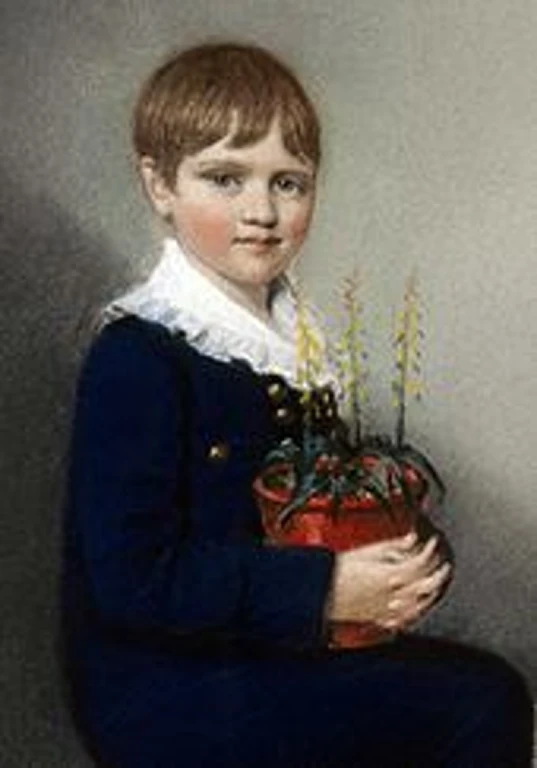
One great idea. 1809 to 1882 Buried in Westminster Abbey. Naturalist and geologist. University of Edinburgh Medical school, University of Cambridge (BA), Geological Society of London. Recipient of: Royal Medal (1853), Wollaston Medal (1859), Darwin established that all species of life have descended over time, from common ancestors. He introduced his scientific theory that this branching pattern of evolution resulted from a process that he called natural selection in which the struggle for existence has a similar effect to the man-made artificial selection involved in selective breeding.
Darwin published his theory of evolution with compelling evidence in his 1859 book On the Origin of Species. By the 1870’s the scientific community and much of the general public had accepted Evolution as a fact. In modified form, Darwin’s scientific discovery is the unifying theory of life sciences, explaining the diversity of life.
Darwin was the fifth of six children born to wealthy society doctor and financier Robert Darwin. His parents were Unitarian and Anglican. He was baptised as Anglican but attended the Unitarian church. He apprenticed as a doctor in 1825 with his brother Erasmus. He learned taxidermy from John Edmonstone, a freed black slave. He assisted Robert Grant in investigating the anatomy and life cycle of marine invertebrates. He learned classification of plants and worked on the collections of the University museum.
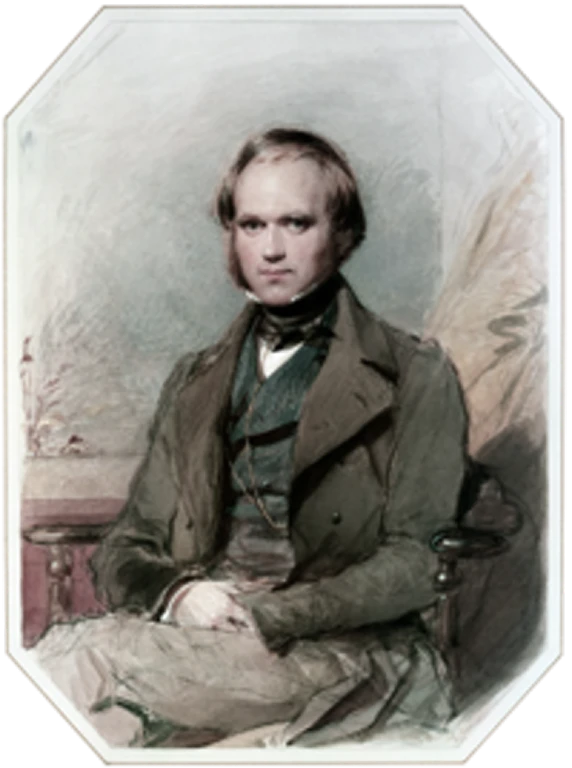
His father sent him to Christ’s college to become an Anglican parson. Darwin’s cousin introduced him to the popular craze for beetle collecting which he pursued zealously. He became a close friend and follower of botany professor John Henslow and met other leading naturalists who saw scientific work as religious natural theology.
He was delighted by the language and logic of William Paley’s Evidences of Christianity. At Cambridge he studied Paley’s Natural Theology or evidences of the existence and attributes of the deity, which made an argument for divine design in nature, explaining adaption as god acting through laws of nature.
He read John Herschel’s new book describing the highest aim of natural philosophy as understanding those laws through inductive reasoning based on observation
Darwin’s early interest in nature led him to neglect his medical education and he studied natural science at Cambridge. His five-year voyage aboard HMS Beagle established him as an imminent geologist and his publication of his journal of the voyage made him famous as a popular author. Darwin’s hope was to study natural history in the tropics.
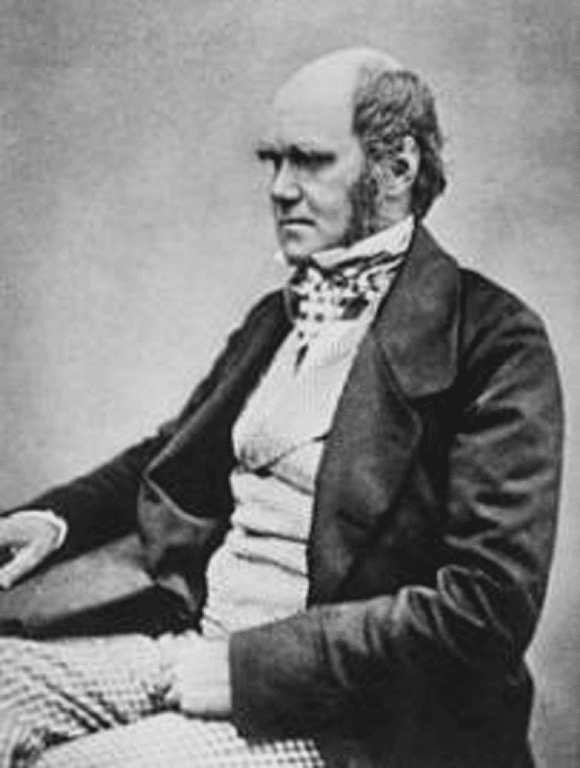
Darwin’s exposure to specimens all over the globe raised important questions. Other naturalists believed that all species either came into being at the start of the world, or were created over the course of natural history. In either case, the species were believed to remain much the same throughout time. Darwin, however, noticed similarities among species all over the globe, along with variations based on specific locations, leading him to believe that they had gradually evolved from common ancestors.
Puzzled by the geographical distribution of wildlife and fossils he collected on the voyage of the Beagle, Darwin began detailed investigations, and in 1883 conceived his theory of natural selection. Darwin’s work established evolutionary descent with modification as the dominant scientific explanation of diversification in nature. Darwin has been described as one of the most influential figures in human history.
4_DARWIN’S BEAGLE
On August 29, Darwin returned home to find a letter from Henslow proposing him as a suitable gentleman naturalist for a self-funded place on HMS Beagle with Captain Robert Fitzroy, as a ‘companion and collector’. The ship was to leave in four weeks on an expedition to chart the coastline of South America. His father objected to the two year voyage, regarding it a waste of time, but did agree to finance his costs.
The voyage began on December 27, 1831. It lasted almost five years.
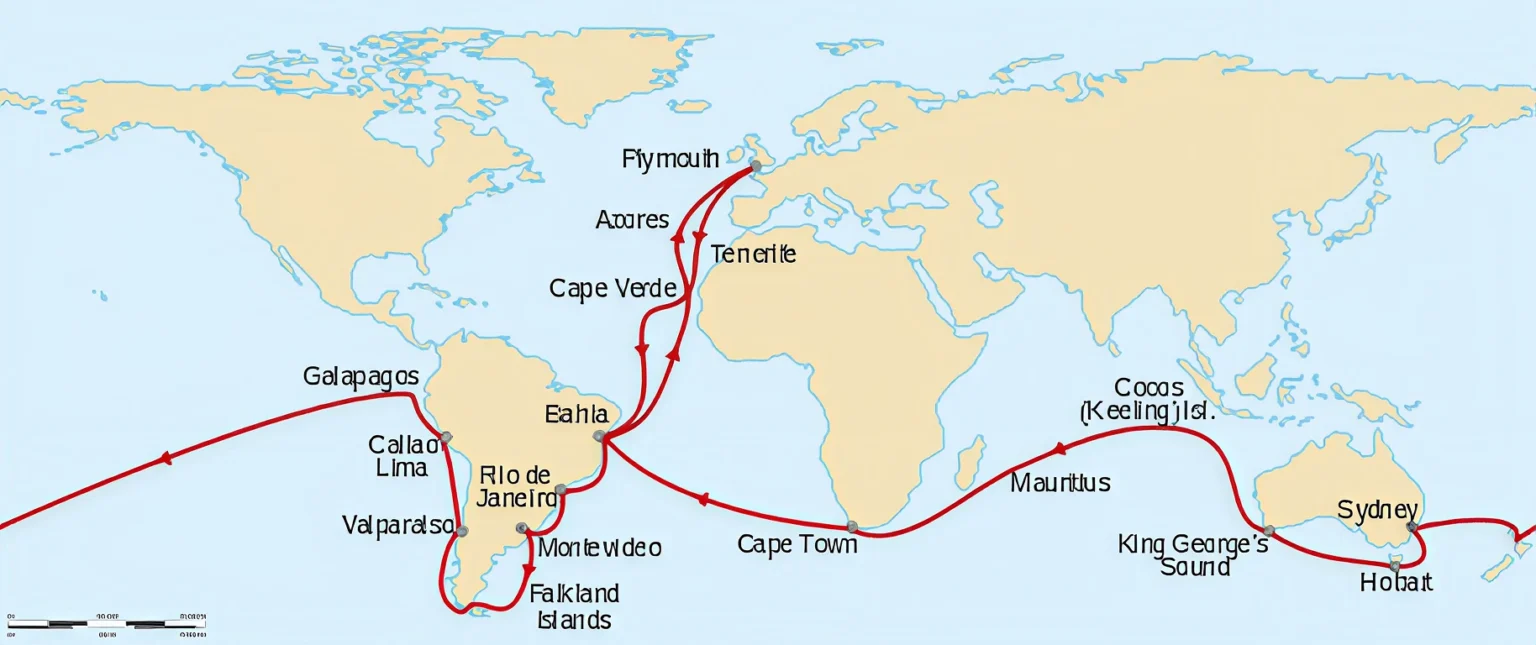 Darwin spent most of that time on land investigating geology and making natural history collections, while the Beagle surveyed and charted coasts. He kept careful notes of his observations and theoretical speculations, and at intervals during the voyage his specimens were sent to Cambridge, with letters and a copy of his journal for his family. Despite suffering badly from seasickness, Darwin wrote copious notes while on board the ship. Most of his zoology notes are about marine invertebrates, starting with plankton.
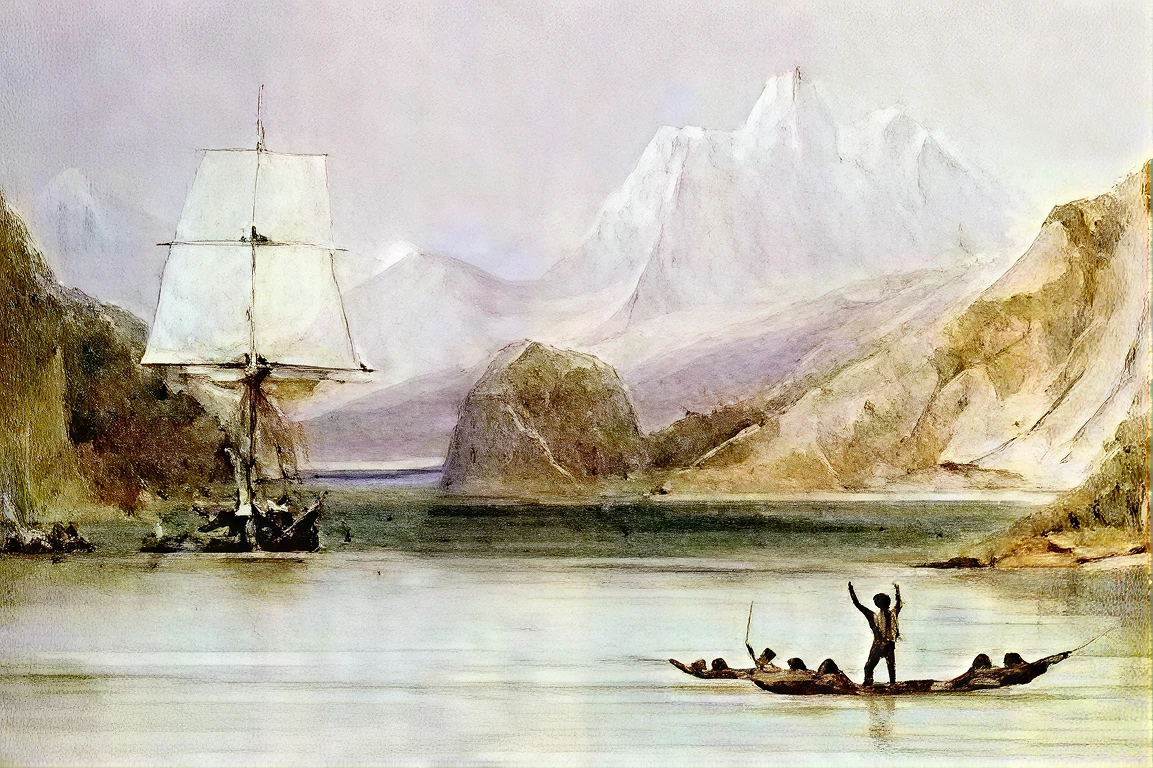
On their first stop ashore at St. Jago, Darwin found that a white band high in the volcanic rock cliffs included seashells. Fitzroy had given him the first volume of Charles Lyell’s Principles of geology which set out uniform concepts of land slowly rising or falling over immense periods. Darwin saw things Lyell’s way, theorizing and thinking of writing a book on geology.
When they reached Brazil, Darwin was astounded by the tropical forest and detested the sight of slavery. In cliffs near Punta Alta, Darwin made a major find of fossil bones of huge extinct mammals beside modern seashells indicating recent extinction with no signs of change in climate or catastrophe. He identified one by a tooth and body armour as a giant version of local armadillos. They brought great interest in England. Darwin gained social, political and anthropological insights into both native and colonial peoples.
Further south he saw stepped plains of shingle and seashells as raised beaches showing a series of elevations. His discoveries challenged his ideas of smooth continuity and extinction of species.
Darwin experienced an earthquake in Chile and saw signs that the land had been raised, including mussel-beds stranded above high tide. He saw seashells high in mountains. When in Australia he noticed a marsupial and platypus so unusual as to comment ‘it was almost as though two distinct creators had been at work’.
When they reached the Galapagos Islands Darwin found mocking birds allied to those in Chile but differing from island to island. Natives could tell which island tortoises were from by slight variations in the shape of their shell.
Fitzroy began writing the official narrative of the Beagle voyages, and proposed Darwin incorporate it into his account. Darwin wrote that if his growing suspicions about the mockingbirds, the tortoises, the foxes and others were correct, such facts would undermine the stability of species.
When the Beagle returned to Cornwall, on October 2, 1836, Darwin was a celebrity in scientific circles who possessed Darwin’s geological records. Naturalists and other experts were enlisted to catalogue Darwin’s large collections and botanical specimens.
Richard Owen used his facilities at the Royal College of Surgeons to work on the fossil bones collected by Darwin. Owen found extinct ground sloths, a hippopotamus sized rodent and others. These extinct creatures were related to living species in South America.
Darwin now settled in to organize his work and rewrite his journal. His first paper on January 4, 1837 showed the South American landmass was slowly rising. He then presented his mammal and bird specimens to the Zoological Society. Ornithologist John Gould announced that the Galapagos birds Darwin thought were a mixture of blackbirds, gros-beaks and finches, were, in fact, twelve separate species of finches.
The Unitarian Harriet Martineau welcomed the radical implications of this transmutation of species. However transmutation was antathema to Anglicans defending social order.
By mid-March Darwin was speculating on the possibility that ‘one species does change into another’ to explain the geographical distribution of living species such as the Rheas, and extinct ones such as the Macrauchenia. His thoughts on lifespan, asexual reproduction and sexual reproduction were used to explain the Galapagos Tortoises, Mockingbirds, and Rheas. He sketched branching descent of a single evolutionary tree.
While developing his intense study of transmutation he received a treasury grant to sponsor his multi-volume Zoology and his planned books on geology and his study of earthworms and soil formation. Over time his research drew on naturalists, farmers, colonists, former shipmates, and other scientists. Darwin’s wide reading included the Principles of population which shows how population soon exceeds food supply and compared this to the struggle for existence among wildlife. As species always breed beyond available resources, favourable variations would make organisms better at surviving and passing the variations to their offspring, while unfavourable conditions would be lost. ‘One may say there is a force like a hundred thousand wedges trying to force into every kind of adapted structure into the gaps by thrusting out the weaker ones. This would result in the formation of new species.
By December Darwin saw a similarity between farmers picking the best stock in selective breeding and nature selecting from chance variants. Darwin now had the framework of his theory of natural selection by which to work. His research included extensive experimental selective breeding of plants and animals, finding evidence that species were not fixed. For 15 years Darwin’s work was in the background of his main occupation of writing reports on the Beagle collections.
In 1842 Darwin’s published the Structure and distribution of coral reefs on his theory of atoll formation. He also then wrote his first pencil sketch of his theory of natural selection. Botanist Joseph Hooker wrote to him, it is like confessing to a murder, I shall be delighted to hear how you think this change may have taken place, as no presently conceived opinions satisfy me on the subject. By July Darwin had expanded his sketch into a 230 page essay.
By November the anonymously published Vestiges of the natural history of creation brought wide interest in transmutation. Darwin scorned its amateurish geology and zoology and it was contemptuously dismissed by scientists.
Darwin completed his third geological book in 1846. He now renewed a fascination and expertise in marine invertebrates by dissecting and classifying the barnacles he collected on the voyage. He showed that slightly changed body parts served different functions to meet new conditions. In some genera he found minute males parasitic on hermaphrodites, showing an intermediate stage in evolution of distinct sexes.
By the start of 1856, Darwin was investigating whether eggs and seeds could survive travel across seas to spread species across oceans. Hooker increasingly doubted the traditional view that species were fixed. However Thomas Huxley was firmly against transmutation of species. Alfred Wallace produced a paper ‘on the law which has regulated the introduction of new species’. Lyell saw similarities with Darwin’s thoughts and urged him to publish to establish precedent. Darwin continued his researches and in September 1857 sent ASA Gray the American Botanist and Alfred Wallace an abstract of his ideas and an abstract of natural selection. Darwin then received a letter from Wallace asking if the book would examine human origins. He responded that he would avoid that subject ‘so surrounded with prejudices’. ‘I go much further than you’.
Darwin’s book was only partly written when Wallace wrote advising he had reached similar conclusions on natural selection. Hooker and Lyell made a joint presentation at the Linnean Society on July 1 on the tendency of species to form varieties; and on the perpetuation of varieties and species by natural selection. Darwin could not attend as his son just died of scarlet fever. Darwin struggled with illness to produce an abstract of his Big Book.
On November 22, 1859 Darwin published On the Origin of Species. It proved unexpectedly popular with the entire stock of 1,250 copies oversubscribed. Darwin set out one long argument of detailed observations, inferences and consideration of anticipated objections. His only allusion to human evolution was the understatement that ‘light will be thrown on the origin of man and his history’.
As many more individuals of each species are born than can possibly survive; and as, consequently, there is a frequently recurring struggle for existence, it follows that any being, if it vary however slightly in any manner profitable to itself, under the complex and sometimes varying conditions of life, will have a better chance of surviving, and thus be naturally selected. From the strong principle of inheritance, any selected variety will tend to propagate its new and modified form.
He put a strong case for common descent and at the end of the book concluded that:
There is grandeur in this view of life, with its several powers, having been originally breathed into a few forms or into one; and that, whilst this planet has gone cycling on according to the fixed law of gravity, from so simple a beginning endless forms most beautiful and most wonderful have been, and are being, evolved. This was the first and only time Darwin used the word evolved in his first five editions of his book. Darwin first used the word evolution in The Descent of Man in 1871 before adding it to the 6th edition of The Origin of Species.
The book aroused international interest, with less controversy than had Vestiges of the Natural History of Creation. Though Darwin’s illness kept him away from public debates, he eagerly scrutinized the scientific response, commenting on press cuttings, reviews, articles, satires and caricatures, and corresponded on it with colleagues worldwide. In April, Owen’s review attacked Darwin’s scientific friends and associates condescendingly dismissed his ideas, angering Darwin. Not finding any other way of discrediting Darwin’s research, Owen and others began to promote ideas of supernaturally guided evolution.
The Church of England’s response was mixed, but liberal clergymen interpreted natural selection as an instrument of god’s design. The cleric Charles Kingsley saw it as ‘just as noble a conception of deity. Seven Anglican theologians diverted clerical attention from Darwin by ideas including higher criticism attacked by church authorities as heresy. In it Baden Powell (boy scouts) argued that miracles broke god’s laws, so belief in them was atheistic, and praised ‘Mr Darwin’s masterly volume supporting the grand principle of the self- evolving powers of nature’. Asa Gray discussed theology with Darwin. Darwin distributed Gray’s pamphlet on theistic evolution, Natural Selection is not inconsistent with Natural theology’.
The most famous public confrontation was at the public 1860 Oxford evolution debate during a meeting of the British association for the advancement of science. The Bishop of Oxford Samuel Wilberforce, though not opposed to transmutation of species, argued against Darwin’s explanation and human descent from apes. James Hooker argued strongly for Darwin, and Thomas Huxley’s legendary retort, that he would rather be descended from an ape than a man who misused his gifts, came to symbolize a triumph of science over religion.
Darwin’s close friends and fellow scientists Gray, Hooker, Huxley and Lyell gave strong support, as did many others, particularly young naturalists. Gray and Lyell sought reconciliation with faith, while Huxley portrayed a polarisation between religion and science. He campaigned against the authority of the clergy in education, aiming to overturn the dominance of clergymen and aristocratic amateurs in favor of a new generation of professional scientists. Owen was discredited for suggesting that humans were a separate biological order from apes.
Darwinism became a movement covering a wide range of evolutionary ideas. In 1863 Lyell published Geological Evidences of the antiquity of man which popularized prehistory. Weeks later Huxley’s Evidence as to man’s place in nature showed that anatomically, humans are apes.
Then the naturalist Henry Bates published The naturalist on the River Amazons providing impirical evidence of natural selection. Lobbying brought Darwin Britain’s highest scientific honour, the Royal Society’s Copely Medal, awarded November 3, 1864.
That day Huxley held the first meeting of what became the influential X Club devoted to ‘Science, pure and free, untrammelled by religious dogmas. By the end of the decade most scientists agreed that evolution had occurred.
The Origin of Species was translated into many languages, becoming a staple scientific text attracting thoughtful attention from all walks of life, including the ‘working men’ who flocked to Huxley’s lectures. Darwin’s theory also resonated with various movements of the time and became a key fixture of popular culture. Cartoonists parodied animal ancestry showing humans with animal traits. These droll images served to popularize Darwin’s theory.
Darwin pressed on with experiments, research and writing. He covered human descent from earlier animals including evolution of society and of mental abilities and the beauty in wildlife. The DNA evidence of today provides that Darwin’s ideas and formulations were and are dead right.
Darwin was a genius to have thought so far out of the box and been able to translate his observations and evidence into a formula for the changes that occur to organisms and are passed on through their descendants. He also provided evidence for the doubling of human populations about every 25 years based on the adaptability of organisms to change. He had compared apes to humans and found that we are apes anatomically. Darwin published reams of articles and scientific papers throughout his life that have provided a base for future sciences.
In 1882 he was diagnosed with what was called “angina pectoris(opens in new tab)” which then meant coronary thrombosis and disease of the heart. At the time of his death, the physicians diagnosed “anginal attacks”, and “heart-failure”.
Charles Darwin died at Down House(opens in new tab) on 19 April 1882. His last words were to his family, telling Emma “I am not the least afraid of death – Remember what a good wife you have been to me – Tell all my children to remember how good they have been to me”, then while she rested, he repeatedly told Henrietta and Francis “It’s almost worth while to be sick to be nursed by you”. He had expected to be buried in St Mary’s churchyard at Downe(opens in new tab), but at the request of Darwin’s colleagues, after public and parliamentary petitioning, William Spottiswoode(opens in new tab) (President of the Royal Society(opens in new tab)) arranged for Darwin to be buried in Westminster Abbey(opens in new tab), close to John Herschel(opens in new tab) and Isaac Newton(opens in new tab).