
Chapter 9
Extinction
Chapter 9
Extinction
MENU
1_PREAMBLE
2_COMMON EXTINCTIONS
3_MASS EXTINCTIONS
4_NUMBER 1
5_NUMBER 2
6_NUMBER 3
7_NUMBER 4
8_NUMBER 5
9_MAMMALS
10_POTENTIAL EXTINCTIONS
1_PREAMBLE
Extinction is defined as ‘the dying out or extermination of living species which occurs when the last member of a species dies, often due to natural, environmental, evolutionary, universal and in some cases self inflicted events such as, in our lifetimes, the ‘Dodo Bird’ and the ‘Passenger Pigeon’. which high lights the impact of human activity on biodiversity.
Over 5 billion species are estimated to have died out. Notable extinct animals have included; non avian dinosaurs, saber toothed cats and mammoths. ‘Survival of the species’ has often been misinterpreted as meaning survival of the strongest or most powerful, when in fact it simply means survival of those species who are best equipped to adapt to their environment. Species become extinct when they are no longer able to survive in changing environmental conditions or against superior competition. The relationship between animals and their ecological systems has been firmly established.
Co-extinction refers to the loss of a species due to the extinction of another species that they are dependent on. The Haarts Eagle became extinct because their main source of food, the Moa, had previously gone extinct. So if all bees died, all flowering plants would die and vice versa. Co-extinction may not be the most important cause of species extinction, but it certainly is the most insidious.
2_COMMON EXTINCTIONS
Isolated extinctions of species are quite common and a natural part of the evolutionary process, however mass extinctions are relatively rare events. Most simply, any species that cannot survive and reproduce in its environment, and cannot move to a new environment where it can do so, dies out and becomes extinct as when toxic pollution renders their total environment unlivable, or when a species gradually loses out in the competition for food to better adapted competitors.
Assessing the relative importance of genetic factors compared to environmental ones as the causes of extinctions, has been compared to the debate on nature and nurture. A diverse or deep gene pool gives a population a higher chance in the short term, of surviving an adverse
change in conditions. Effects that cause or reward a loss in genetic diversity, can increase the chances of extinction of a species. There are many book references on this topic such as Sir Martin Rees book, ‘Our Final Hour’.
I believe that the extinction of the ecosystems is the main cause for the extinction of the species, and that the extinction of natural living parameters is the main cause of the extinction of the ecosystems.
3_MASS EXTINCTIONS
There have been at least 5 documented mass extinctions in Earth’s geological history. The evidence shows 4 of them in the last 350 million years.
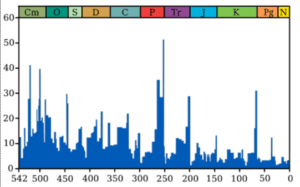
A) Time runs from left to right (millions of years ago). Blue is the apparent percentage of marine animal genre becoming extinct. There have been 5 well recorded mass extinctions and several smaller ones. Many more may be uncovered in future archaeological discoveries. We must be clear on what is meant by ‘mass extinction’. There is a natural background rate to the timing and frequency. Evidence shows that 10% of species are lost every million years and 65% every 100 million years. Extinctions are a natural and periodical part of evolution. A mass extinction occurs when at least 75% of species go extinct typically within a period of 2 million years.
4_NUMBER 1
The first recorded known mass extinction, known as the Ordovician-Silurian extinction, happened about 443 million years ago and resulted in the loss of about 85% of Earth’s species.
Intense glacial and inter glacial periods created large sea level swings and moved shorelines dramatically. The tectonic uplift of the Appalachian mountains, created enormous weathering, sequestration of CO2 with changes in climate and ocean chemistry.
5_NUMBER 2
The Late Devonian Extinction happened 360 million years ago and resulted in the loss of about 75% of Earth’s species. Rapid growth and diversification of land plants generated rapid and severe global cooling.
6_NUMBER 3
The End Permian Extinction happened 250 million years ago and resulted in the loss of about 96% of Earth’s species.
Intense volcanic activity in Siberia caused global warming. Elevated CO2 and sulfur levels from volcanoes caused ocean acidification, acid rain, and changes in air, ocean and land chemistry.
7_NUMBER 4
The End Triassic Extinction happened about 200 million years ago and resulted in 80% loss of Earth’s species.
Underwater volcanic activity in the central Atlantic caused global warming and a dramatic change in the chemical composition of the oceans.
8_NUMBER 5
The End Cretaceous Extinction happened 65 million years ago and resulted in 76% loss of Earth’s species, including the dinosaurs.
Approximately 65,000,000 years ago a very large rock from space hit Earth in what is now the Yucatan Peninsula on the tip of Mexico’s eastern extent. It is called the K T Event and it changed the earth and all life on earth, forever. The evidence is most clear, a 112 mile diameter crater discovered beneath sediments of the Yucatan Peninsula near Chicxulub Mexico. In addition tektites (fractured sand grains indicative of a meteor strike) and Iridium, (rare on Earth but common in meteorites) are found in a layer of 65,000,000 year old sediments worldwide. Other evidence includes worldwide tsunamis and wildfires. For the dominate life forms this was a catastrophic event. It eliminated about 76% of all animal species including the dinosaurs and many marine invertebrates. For mammals including us humans this was a fortuitous happening.
A rock the size of a large city travelling at high speed contains an incredible amount of energy. Remember Einstein’s famous equation E=mc2. This means that Energy is equal to the object’s mass times the speed it is travelling, squared. If you threw a bullet at a wall, chances
are it will just bounce off. If you shoot the same bullet from a rifle at 954 miles per hour, the energy is multiplied by the speed of the bullet multiplied again by itself. This is an enormous increase in energy created by the speed of the bullet and can penetrate steel.
Ok first step, imagine a rock the size of a truck crashing on earth at 30,000 miles per hour. It would have the amount of energy equal to the nuclear bomb that fell on Hiroshima during the Second World War. We have the experience to verify these results very clearly.
Next, If the asteroid was the size of a 20 story building at 30,000 miles per hour it would generate on the order of 20–100 megatons. This is enough to completely destroy most major cities in North America.
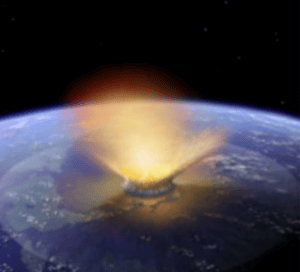
Then, imagine an object such as a 1 mile wide rock travelling at 30,000 miles per hour and it hits our earth. This is a big jump from the 20 story building. An asteroid that big, travelling at that speed,
has the energy roughly equivalent to a 1 million megaton bomb. It is very likely that an asteroid that big would wipe out most life on earth. It’s very difficult to imagine a 1 million megaton bomb. This is 10,000,000 (10 illion) times greater than the bomb that fell on Hiroshima in 1945. The amount of dust and debris thrown up into the atmosphere would block out the sun for months, even years, and cause most living things on the planet to perish.
Now, The KT Event was much more massive than any of the above scenarios. At 6 miles diameter and a speed of over 30,000 miles per hour the energy released from this impact event caused worldwide devastation, and the extinction of thousands of species of life on earth. Plant life was decimated, by the world wide shock wave, fires, and by the dust and debris filled sky reducing sunlight. Large plant eaters that survived the initial catastrophic effects of the KT collision starved as a result of scarce plant food. Surviving carnivores had very little option but to eat of their own kind.
9_MAMMALS
Fortunately for us, most mammals at that time, were somewhat protected from the KT catastrophe due to their primarily underground existence. This protected them from the above ground effects of the KT Event and mammals survived to populate every corner of the earth. Guess what? Are we a mammal or not? Mammals like to multiply. Mammals developed a longer life span, and access to new environments due to their main above ground predator’s demise, and the emergence of more favourable conditions. The dinosaurs might still rule, and we might be scurrying about trying to stay alive, if not for the KT event.
I find it ironic that the Universe is 99.99% trying to kill us and all life. The other .01% extinctions are self inflicted. Could we exist for even seconds outside of our tiny enclave without extraordinary technology?
10_POTENTIAL EXTINCTIONS
Some scientists have argued that we are entering a ‘Sixth Mass Extinction’ with the new cause being biological annihilation by humans rather than a city sized asteroid. However, a recent study published in the journal PLOS Biology argues that while the decline in biodiversity is real, insects, plants and animals are not disappearing at rates anywhere near approaching a mass extinction.
In fact, the analysis also suggested that genus-level extinction rates appear to have been declining and are very rare across plants and animals, and were found only on islands where extinction rates have actually slowed down over the past 100 years and that over the past 500 years a small fraction of life on Earth has gone extinct representing only .45% of all genera. (not including insects, the largest genera of all).
They conclude that rates of extinction may be decelerating partly due to intensifying conservation efforts particularly for mammals and birds.
There in no imminent danger from major extinction events for any future descendants of ours, excluding alien invasions assumed by some, or a suicidal nuclear war predicted by others. Relax.